Friday, June 15, 2012

Assumptions.

I had a really great conversation with someone in my family last night, and it prompted me to clarify something.  This may get a bit deep, but I'll try to be as clear as I can.  It's also long, so proceed at your own risk.

All Christians, Evangelical, Mainline or Catholic proceed from a certain set of assumptions.  Most Catholics, for example, don't make a "personal relationship with Jesus" a central part of their faith and practice.  They experience God primarily through liturgy and sacrament and interpret Scripture within the context of not just the local parish community, but within the wider Catholic traditions of the last 1,500 years or so.  Evangelicals, who centralize a personal, experiential relationship with Jesus and a clear, memorable "conversion experience" are horrified by what they regard as paganism by the Catholics, while Catholics are flabbergasted by arrogant, populist Evangelicalism.  Both proceed from their own assumptions, which are based on their interpretation of - you guessed it - the Bible.

Let's take this a step further.  All orthodox Christians assume the doctrinal truth of the Trinity.  The Bible, however, does not directly teach trinitarian doctrine anywhere.  It is an invention of the third and fourth centuries AD, arrived at as an interpretation of several passages, and it was by no means uncontested.  The wording of the Nicene Creed reflects the controversy.  It does not say "we believe in a trinitarian God," it says "we believe in one God," and then goes on to clarify the three persons.

So do we believe in one God or three gods?  A Muslim would insist that we believe in three Gods, and if we equate the words "God" and "Allah" (and I would), then to an Muslim now we're engaging in idolatry.  Explain it any way you want, and the result is the same. 

The thing is, the Trinity rests on a bunch of assumptions of which most Christians are not aware.  It is a product of a Greco-Roman way of ordering theology.  Greek philosophy had no trouble distinguishing between distinct things, entities or identities while maintaining a cohesive unity.  They saw it all around them, after all.  A tree was both unity and multiplicity, a single thing  made up of constituent parts that informed and defined it.  The Greeks saw each person as a whole greater than the sum of his or her parts.  Their pantheon of gods reflected this, as each individual deity was really no more than a reflection of an aspect of Divinity.  When Christianity came along, the Greco-Roman world had no trouble at all with the concept of a trinitarian God because it had an epistemological framework ready-made.

But it goes even further than that.  Greco-Roman society was rigidly structured, an orderly hierarchy into which each person fit in a specific place.  The layers were somewhat permeable; one could move up the ladder, as it were, but only with the help of someone at the next level, which made the complex web of kinship and patronage critically important.  Honor was found not in rising above one's station, but by fulfilling one's purpose in the social order to the best of one's ability.  Paradoxically, a person who wanted to rise through the ranks would not do so through self promotion, but by strict attendance to the obligations appropriate to his or her rank.  The idea of a well-ordered, eternally static Trinity made up of persons with distinct roles fit perfectly into Roman society (or was it a product of Roman society?).

The Trinity was not a universal concept though, not even for Christians.  It was largely a doctrine of the Western Church, which quickly imposed the social order on the church, rigidly ordering it with pastors, priests, bishops, archbishops and so on, and on the Trinity, which it ordered neatly in terms of the Roman household: Father, Son and Spirit (wife).  Although the official formulation recognized that all members were co-equal, the Church historically has framed the Trinity in subordinationist terms (Father, then Son, then Spirit).

The Eastern Church, however, made very different assumptions.  It arose in a culture that did not order itself as rigidly and though it accepted the general hierarchy of the Western Church, it consistently pursued a more community-based daily practice.  One might say that the Western Church emphasized the oneness of God, while the Eastern Church emphasized the threeness.  This has had all sorts of implications for the way these two strands of the Church have organized themselves.  We Evangelicals are a product of the Western Church and have inherited much of its theology and organization.  Much what we believe about God, which we think comes directly from the Bible, is really based on a framework of Greek philosophical understanding.  The salvation experience, a personal relationship with Jesus, conversion, the Trinity - all rely on the assumptions that Westerners bring to the table, and are not shared by much of the rest of the world.

Arab culture, for example, has arisen under very different circumstances.  The geography and climate made cooperative effort critically important.  Since resources were scarce, Arabs organized their society in tribes that were more flexible and mobile so they could easily relocate when circumstances demanded it.  While there has always been a hierarchy, the tribal structure and the importance of cooperation made it much less nuanced.  There was the Sheikh and his family, and then everybody else.  There was little exploitation though, and so no need to form a more stratified social order.  The difficult conditions under which life was lived demanded cohesiveness; oneness and unity were matters of life and death

Islam reflects this understanding.  There is Allah and there is Muhammed, the Prophet of Allah.  While Muhammed is revered above other men, he is not Allah.  Islam emphasizes the oneness and singular importance of Allah, around which every other element is arranged.  Arab Muslims have one God, complete in himself and in whom all mankind finds completeness and unity, and there is no societal framework for conceptualizing something like a Trinity.  It's not that they're not intelligent enough to understand it, or that they don't want to understand it, but that it simply doesn't make the slightest bit of sense to them because they come to the table with a completely different set of assumptions.  The fine distinctions Western Christians make between the persons of the Trinity sound like contradictory nonsense.  Arab Muslims proceed from an extremely conservative interpretation of the Koran, which is read only in the original Arabic and only by men trained to do so; consequently, our formulation of doctrine by implication (rather than strict literal interpretation of Scripture) also doesn't work for them.

This is a very long post to say this: don't be too sure that the things you believe proceed directly from a clear, unadulterated understanding of Scriptural truth directly from God.  God speaks to people in ways that they comprehend; if he wanted to reveal himself to an Arab, would he not do so in a language and culture that he could grasp?  After all, the fact that you're Christian is largely because you were born in America (the heir of the Roman Empire) and that the Roman Empire adopted Christianity early on, and that happened because God revealed himself to Jews in first-century Palestine.  If you are a Christian, it is mostly by virtue of your birth into the Western world.  Were you born in Riyadh, Saudi Arabia, you would be Muslim.  Were you born in India, or in much of Asia, you would be Buddhist.  In neither case would much of what Christians believe make any sense to you no matter how carefully put. 

Do you really want God to reach the world?  The WHOLE world?  Then you might have to release some of your hangups about how he does it.  There are distortions in every belief system; God asks everyone to change something, Christian, Muslim, Buddhist or otherwise.  Let God do things his way; don't impose your assumptions on it.

Thursday, June 14, 2012

Obvious

I once delivered a sermon in which I contended for a God who was obvious, asserting that those who seek him will always find him.  I said that the "narrow gate" of Matthew 7 was really a warning intended for clean-living Christians, who have a greater capacity for self-righteousness than the hooker down the street.  I said that the "narrow gate" is really like a huge archway; just turn around and it's right there.  You can't miss it.  Once you walk through it, there's just open space.  You can't get lost.  You can't make a wrong turn.  You needn't worry about all of that because it's not the point.  I was simply telling people not to make it any harder than it actually is, not for themselves or for anyone else.  Don't impose artificial conditions.  Don't put up flaming hoops for people to jump through. 

You would not believe the kind of angry resistance I got.  Many Christians are deeply offended by the idea that it could be this simple, but there's nothing new about it.  Jesus says similar things to the Jewish religious elite time and again.  It's not heresy.  Patrick of Ireland (otherwise known as St. Patrick) composed this famous little prayer:

"God above me.
 God below me.
 God in front of me.
 God to my left, and to my right.
 God in every eye that sees me.
 God in every ear that hears me.
 God within me.
 Amen."

In Matthew 5:6, when Jesus says "[b]lessed are those who hunger and thirst for righteousness, for they will be filled," he doesn't mean "good moral behavior."  The Greek word dikaiosune refers to one's covenant standing with God, which is purely a function of his gracious activity.  God's covenants, through which he expresses his love for us, are entirely one-sided.  The katharos kardia ("pure heart") Jesus mentions in verse 8 should be understood in that light. 

Later, in Matthew 7:7, Jesus says "[a]sk and it will be given to you; seek and you will find.  Knock and the door will be opened."  It's important to understand the way Greek grammar works here.  When we use the future tense in English, we typically are referring to some unspecified point in the future.  While that can be true in Greek, the future tense is also used in what is called the future imperatival sense.  It indicates a causal relationship, two things inextricably bound together.  If you do this, then that will happen.  The Ten Commandments in Exodus 20 are written in the future imperatival.  Why?  Because they come with an implied, "or else." 

What Jesus is saying, in other words, is that those who seek him will always find him.  He's not hiding.  He's not making himself intentionally difficult to understand.  He doesn't obscure himself in any particular culture or limit himself to any one sacred text or another.  While he refuses to be neatly packaged, marketed and consumed, he also refuses to be nailed down and defined in any one creed, tradition or experience.

He is not a narrow gate, or the eye of a needle.  Open your eyes and you will see him.  Turn around and you will find him.  You will find him in the words of many sacred texts because Jesus is not the container, but the contents.  He is not the menu, but the meal.

So relax.  There are many ways to seek God, and if you seek him you will find him.  When you do, he will make sense because he wants to make sense to you.  He wants you to understand him.  If God does not seem obvious, it's not because you're not trying hard enough, but probably because you're trying too hard.

Wednesday, June 13, 2012

Myth

People tend to equate "myth" with "untrue story," but myths are actually stories that tell deep, abiding truths about who we are as human beings.  The Bible, for example, is full of "myth," and that doesn't mean it's not true.  The great contradiction is that Christians tend to dismiss the stories told by other people as "myth" (applying the "untrue story" definition), but insist that our own are somehow different, somehow more true.

There is a Greek myth about a man named Narcissos (Americans have typically made Narcissos a woman because of the assumptions we make about gender), who sees his own reflection in a pool of water, falls in love with it and, unable to leave, wastes away and dies. 

Evangelical Christianity, in many ways, is Narcissos.  We have fallen in love with our own reflection.  We reject anything we do not understand or cannot shoehorn into (or extract out of) the Bible, which we follow instead of God much of the time.  Instead of looking for deep, God-given truth anywhere we can find it, we've decided that the only place God has ever truly revealed himself is in our sacred text.  Anything else is nothing more than false truth.  Sure, it may seem like truth, or peace, or goodness, but it's really just a "counterfeit" sent by the devil to fool us.

The Bible, by the way, is the reflection I'm talking about.  Evangelicalism largely doesn't bother to really examine what the original meaning was; instead, we formulate doctrines or rules based on our own cultural prejudices, and then find justification for them in a mis-reading of the Bible.  Women in ministry and the big moral issue with the gay community are two obvious examples.  It's not God that hates women and gay people, it's Christians.

Truth arises in many places, including many sacred texts.  That doesn't mean one has to accept every tenet of every faith as God-given, as people introduce distortions into everything God does.  It's unavoidable.  But we must not dismiss truth because it didn't come from the Bible.  We must not insist that the whole world adopt our version of "truth," which is much less about the Gospel than it imperialism, and the wholesale adoption of conservative capitalism wrapped in a (very) thin layer of Christianity.  We must allow God to speak to different cultures in different ways and yes, sometimes wearing a different face.

We might just have to accept that, were God to desire to form a relationship with a non-Western culture, he might just look like one of them and speak in ways that would make sense to them.  We might have to see that the "narrow gate"** is far wider than Christians may want it to be. 

I mean, really, does anybody honestly think that Gandhi didn't know God?


**The "narrow gate" analogy in Mathew 7 isn't about non-believers.  Jesus is talking to the Jewish religious elite, warning them that their identity badges, all the things they think make them part of the in-crowd, won't get them very far.  In other words, the "narrow gate" applies to Christians, not non-Christians.  It's not non-Christians who find themselves on the "wide road" that "leads to destruction," but Christians.

Monday, April 2, 2012

Soul-eyes

What we call the "soul" is that part of us that is made to comprehend the grand mystery that is God. When I say "comprehend," that is exactly what I mean. We cannot "know" God in the sense that we can know a math problem or even the way we "know" another person. The issue is, whatever we think we "know," God is infinitely more than that. So in this relationship there is, rather than an infinite regression as we find in philosophy, an infinite ascension; we come to some conclusion, realize that God is more than that, and then reach beyond it to the next conclusion.

The problems start when we misuse our soul-senses, which are designed to see and not to be seen. If we turn these senses away from the One who created them, pointing them inward to the task of self-scrutiny, then we create a kind of feedback loop in which we dredge up the very worst in ourselves, hold it to the light of discovery, and then consume it instead of offering it to God. We return again and again to view the things that distort the image of God, trying desperately to do what only He has the grace to do. Most of us are constitutionally incapable of not doing this. Perversely, it is another part of our basic fallenness.

And so we return to the purpose of the soul: to gaze upon the omnipotence and the immanance of God and to offer itself in a continual act of self-immolation. The self is destroyed, the ego is dethroned, and the soul is re-united with our bodies and our emotions. It is an act of re-creation. The false self, which judges itself harshly by what it does or achieves is minimized and the true self, which perceives itself solely as it relates to God, comes to the fore. The Fall is reversed and God achieves the goal of the cross: the redemption of whole people.

Christ is risen.

Friday, March 30, 2012

Offense

Matthew 13:53-58 relates the story of Jesus coming back to his home town, presumably after a lengthy time away. He started off by teaching in the synagogue, which was probably par for the course for itinerant prophets. Jesus is different though, and the townspeople recognize this, as had others (see Matthew 7:29).
Their reaction is different than Jesus' audience outside his home town. The passage implies that they grumble to themselves, "where did this man get this wisdom and these miraculous powers? Isn't this (just) the carpenter's son? Isn't his mother's name Mary, and aren't his brothers James, Joseph, Simon and Judas? Aren't all his sisters with us? Where then did this man get all these things?" (13:54-56)
The next verse is critical: "And they took offense at him." (13:57)
They think Jesus is getting above his station, that he's putting on airs, pretending to be something that he's not. Tradespeople were at the lowest end of the power and influence scale in first-century Jewish society; by right, Jesus should have taken up his father's trade. His choice not to do that probably brought shame to his family. They won't listen to what he's saying because they can't get past who they think he is.
Consequently, Jesus "did not perform many miracles there because of their lack of faith." (13:58) It's not that Jesus' power was diminished, as though it were linked to the amount of faith available. He simply understood that any miracle would have been misinterpreted and distorted. If they would not believe based on the strength of his teaching, what good would a miracle do? Even if they followed him, they would have done so for the wrong reasons.
I do the same thing with Jesus all the time. I get stuck on my own perverse understanding of who the Savior is, and I stop listening. I won't leave my agenda and take Jesus for his (which is what "repent, and believe the good news" means), and as a result there isn't much he can do for me. My heart is hard, my eyes are closed and I am hard of hearing, as Jesus would put it (quoting the prophet Isaiah). Anything he did for me would simply be misinterpreted. I would follow him for all the wrong reasons.
We follow the broken, bleeding One, the Son of Man who abdicated the throne and became humble, just like us. If we make Jesus into another power source, something we engage so that we can be victorious over sin, then we miss the point, I think. We close our eyes to the powerlessness and humility that God intends for us to see and to model. Jesus simply reinforces our already-raging egos, which feed fantasies of accomplishment, achievement and perfection.
We are supposed to see the carpenter's son whose brothers and sisters live next door to us, the son of Mary, a man like us in every way. We should take full account of Jesus' humanity and not reject it in favor of divine power. We must turn to face the naked, suffering Jewish man executed on a cross by the Roman government.
We must accept him as he presents himself to us and not remake him in our own image.
"Blessed is the one who does not take offense at me." (Matthew 11:6)

Tuesday, March 27, 2012

Am I my Brother's Keeper?

Among the Christians that I know, much the debate around the concept of universal healthcare, or an expansion of the social welfare state in general, revolves around one question: why should I pay for someone else's healthcare? Let's look at this a couple of ways.

The title of this post is Cain's response to God when God asks Cain where his brother is (as if God didn't know). Cain knows perfectly well that he killed his brother, but says to God, in effect, "how should I know? Am I my brother's keeper?" Everything God does next shows us that the answer to that question is a resounding YES. God later enshrines this concept in the Law, which explicitly provides for the people on the lowest rung of the power and influence ladder. We are responsible for each other. We are responsible to God for the kind of society we create. Jesus takes issue with those who have a lot, telling them that if they're relying on it to "save" them, then they should also try getting a camel through the eye of a needle. This is Jesus at his sarcastic best. If you hate the idea of "your" resources being used to fund other people's medical expenses, then Jesus might be talking to you.

From a social-political perspective, there is nothing new about these debates. We were having them in the 1930s when FDR was sculpting what would become the Social Security Act of 1935. Oddly enough, most Americans were fine with the idea of social welfare, but that's because the middle-class was on a par with the working- and lower-classes. The Great Depression was also the Great Equalizer. That said, there was plenty of push-back, mostly from corporate America, the American Medical Association, and conservative churches, all of whom considered the ideal of American individualism, the rugged pioneer surviving on his wits with his family in tow, to be sacrosanct. There were all kinds of financial interests mixed in there too, of course. In the end, FDR managed to get the Act through Congress minus universal healthcare, which the AMA was successful in killing.

So what happened between now and then? The 1950s happened. After the War, the U.S. entered a period of stability and prosperity (which was an inch deep at best...read Elaine Howard May's "Homeward Bound" if you want to know more). It was also a time of stifling conformity. Prosperity became the norm; anything else became a form of deviance. Old values began to emerge: if you were poor, it was because you were lazy. Or black or Hispanic. Because everybody knew that they were shiftless. Racial tensions that remained dormant during during the War awoke with a fury. The almost exclusively-white suburbs looked to the edge of the cities, to the ghettos teeming with brown-skinned people who had moved there earlier in the century, and they began to get angry.

Nevermind that there have ALWAYS been more poor white people than poor black people. Nevermind that there have ALWAYS been more un- or underinsured white people than black people. Still the image persists: the recipient of state health care, ADC or other welfare programs is a black women living in the projects with her four illegitimate kids by three fathers, none of whom are around anymore. Why should we pay for that, huh? They should get jobs and take care of themselves, just like we do, right?

Who are you thinking about when you think of someone without healthcare? Let me help. Hannah and I don't have any health insurance. We haven't for probably six years. It happened when Blue Cross/Blue Shield began to increase our rates 27% a year. We finally had to drop it when the monthly premium reached $1300 a month. It was more than our mortgage, and over twice as much as BOTH of our car payments combined. Our kids are covered by the State of Georgia, thank God. But if anything happens to Hannah or me, we're screwed.

There. Does that put a face on it? Are you your brother's keeper? Are you my keeper? Hannah's keeper? Would you sacrifice some of the luxuries in your health plan so that Hannah and I could see a doctor when we're sick? Because we do get sick you know. We need yearly preventative care just like you do, but we don't get it because we have to choose between feeding our family and getting medical care. I *have* a job. Two of them, actually.

It's easy to stand on principle when you're not the one suffering. It's easy to create caricatures and subtly racist straw men. The real face of the health insurance crisis looks just like Hannah and me, though.

Are you your brother's keeper? I hope so, for their sake and for yours.

Monday, March 26, 2012

I have a big mouth. And sausage fingers.

Hi. I'm Frank. I'm addicted to arguing about stuff on Facebook. I've been clean for about two weeks, and I have to admit that I don't miss it much.

I also must acknowledge that I have a tendency to go way too far in defense of a point. Aggressiveness and rudeness are never justified, even if it's a *really* good point. I also confess that I have a near-pathological aversion to trick questions or "I'm going to straighten you out" kind of language. As soon as I detect either one (and both are commonly aimed at pastors), I go after that poster with all the powers of intellect and persuasion at my command. It's not very nice, and I shouldn't do it. All that to say, there are some very good reasons for me to steer clear of forums like Facebook and confine those kinds of discussions to one-on-one encounters.

There's something bothering me though.

There's an implicit expectation on the part of many of the Christian people I know that we should never engage in any controversy of any kind, that no issue is worth standing one's ground over at the risk of being divisive. In his "Letter from a Birmingham Jail," Martin Luther King Jr. said "so often the contemporary church is a weak, ineffectual voice with an uncertain sound." I agree with him. In his day the issue was racism. Most denominations refused to take a stand for fear of alienating their more conservative members (who were frequently the biggest givers as well). They talked a big game about "unity," but it was really little more than rank cowardice. For the sake of unity, the church was complicit in a heinous, systematic sin.

That's the way I have come to view huge portions of the American evangelical church today. They're all about the love of God, so long as we limit it to people who are like us. We're all about the poor so long as it's about minimal sacrifice and good feelings and not about addressing political and economic institutions that oppress them (because that might cost us middle-class white folks a lot more).

This position is chuck-full of double standards. Fighting for health care for everyone? DIVISIVE! Fighting for a constitutional amendment outlawing gay marriage? That's fine. Arguing against the next war? INSENSITIVE AND UNLOVING! Agitating to make abortion illegal or picketing a clinic? Not only is it not wrong, it's our DUTY! Moreover, it seems that the disunity comes only from the liberal side, but the conservative side is protected by a blanket of piety and patriotism. It's funny how some Christians are all about the Gospel being a "sword" until they're on the pointy end. Then it's all petulance and whining about the meanness of it all.

I conducted an informal experiment last week. I listened to the most conservative Christian radio stations I could find for seven days in a row. I found that they were, between infrequent songs, little more than a medium by which conservative political values are propagated. They talked politics not once or twice, but EVERY SINGLE DAY, multiple times per day. It wasn't about abortion either. It wasn't about gay marriage (this week). It was about "Obamacare," which is in the Supreme Court for oral arguments this week. Every DJ was clear about his or her message, too. No ambiguity there. They wouldn't even use the title "President," instead derisively, disrespectfully referring to the president by his last name only as though he were a football coach. Christians have to pray for "Obamacare" to be repealed in the name of American Freedom! The worst part was when they'd pray that God would grant wisdom to the Justices so that his will would be done here on earth.

God's will? forty to fifty million people un- or under-insured to the extent that they can't see a doctor when they're sick is God's will? When is that ever God's will?

Beyond the hypocrisy and callousness of it lies the church's revolting capacity to be the "archdefender of the status quo. Far from being disturbed by the presence of the church, the power structure of the average community is consoled by the church's silent--and often even vocal--sanction of things as they are" ("Letter from a Birmingham Jail" again). I'm not the first one to notice it. People like Washington Gladden, Robert Ely, Caroline Crane, Elizabeth Stuart Phelps, Bishop Francis McConnell, Charles Stelzle, Shailer Matthews, Walter Rauschenbusch and Harry Emerson Fosdick wrote extensively on it.

I will admit that Facebook is probably the wrong forum for these kinds of discussions, but I utterly reject the notion that the church should take no public stance on issues of injustice. Political injustices require a political remedy; economic injustices require an economic remedy, and the church can and should have a voice in all of it. Where one side pushes a gospel of bigotry, cruelty and exclusion, the other side must push back to bring balance to the message.

Enough damage has been done by a Church full of silent, compliant pastors. I'm not one of them. I hope you're not either. Harry Emerson Fosdick said

"A man who says that he believes in the ineffable value of human personalities and who professes to desire their transformation and yet who has no desire to give them better homes, better cities, better family relationships, better health, better economic resources, better recreations, better books and better schools, is either an ignoramus who does not see what these things mean in the growth of souls, or else an unconscious hypocrite who does not really care so much about the souls of men as he says he does." (Christianity and Progress, 48)

Monday, January 23, 2012

Right Speech

I'm going to write something that will probably confuse some of my Christian friends. I'm hoping not to cause offense, which to me means sort of insensitively causing senseless injury. On the other hand, I'm okay with "provocation" so long as there's room for disagreement. Personally, I think Christianity is plenty big enough for varying ideas. So, here goes.
I think there's truth in other religious perspectives. Lots of truth. Like, "Truth" with a capital "T." If you're finding yourself wanting to burn me at the stake, take a deep breath and keep reading.
I've been considering the Buddhist Eightfold Path, and I can't help but notice how much of it mirrors what we find in the Christian Bible. The Tenets of Right Speech have been particularly amazing. Here they are:
1.) To abstain from false speech, especially not to tell deliberate lies or speak deceitfully.
2.) To abstain from slanderous speech or use words maliciously against others.
3.) To abstain from harsh words that offend or hurt others.
4.) To abstain from idle chatter that lacks purpose or depth.
Practicing these them has had an interesting effect. It is bringing me into a sort of interrogative relationship with my thoughts because I have to examine them against the four tenets. I find that I have to retract, alter or mitigate about half of what I say after I say it because I speak too quickly. What an realization! At least half of what I say is inaccurate, untrue or unnecessary. To put it another way, I could be listening twice as much as I do now.
You'll find every one of them in the Bible from the very mouth of Jesus. Check the gospels and see for yourself. Does it make any difference whether it comes from Jesus or the Eightfold Path? I don't think so.
Justin Martyr, a first century Christian philosopher and apologist (also known as Saint Justin) said, "(w)here you find truth, there you will find God." I agree completely.

Tuesday, November 1, 2011

Obil.

1 Chronicles 23-27 details the jobs that David assigned to various people as part of the Temple-building project near the end of his life. There were men in charge of music and sacrifices, military divisions and the city gates. The Twelve Tribes were reorganized and leaders were assigned. David is transitioning his kingdom from a wartime footing to a peacetime footing in preparation to hand it all over to his son, Solomon.


Obil was in charge of camels. Not the divisions or the musicians or the treasury - just camels. That's what God called him to. Camels.


The thing is, somebody had to watch the camels so that they'd be where they were supposed to be when they were needed. I mean, you couldn't have camels wandering all over Israel could you? In that part of the world, Camels were (and still are to some degree) an important piece of the economy. They provided milk, and meat. They were pack animals, able to endure conditions that would have killed another animal. Camels were the means by which Israel transported goods to market, so they were probably the most important animal in terms of Israel's economy.


But...man. Camels are boring. Not only that, but they're cranky and they STINK. Predictably, there was little status associated with watching camels, or any other herd animal. It was a job for the lower class. Obil would never cross class boundaries to become a leader of the tribe. Watching camels was his lot.


The fact that the passage spends exactly zero time articulating Obil's opinion of his station is telling. Clearly, the Bible doesn't seem overly concerned with how Obil felt about his lot. It simply assumes that some people are called to watch camels, and that there's nothing wrong with that.


I mean, why would any of us assume that we're *not* Obil? Are we so presumptuous as to reject what God calls us to in favor of something that comes with a more promenent status? Why would we think that God would never call us to give up something we love to watch camels?


I think scripture teaches precisely the opposite. It's better to herd camels, if that's what God calls you to, and never aspire to anything else than to spend your life trying to achieve something "better." If you do, then you'll be miserable if you don't attain it, and even more miserable if you do. Doing the ordinary thing that God has called you to, the thing that's right in front of you today, is better than anything else you could be doing at this moment.


Obil watched camels, and I think he was happy.

Tuesday, October 25, 2011

The Argument for "professional" Pastors...

This may come across as self-serving, but can I make a case for full-time, professional Pastors? By "professional" I mean that he or she gets paid to do it and doesn't do anything else. Let me just say that my wife and I happen to pastor an amazing church full of people who really want to take care of us, so I'm not really writing this for our benefit specifically. It's just a general discussion. Good. Here we go.


First, to answer the question "what do you do all day anyway?" Let's just say that anytime you try to get a large group of adults and about as many kids to all move in the same direction at roughly the same time, you'll have some practical details to work out. By "some" I really mean LOTS. Believe it or not, the work of God actually has a very pragmatic side that your Pastors never expose you to.


Second, people's crisis don't follow bankers' hours. Your Pastors don't shut off their phones at 6pm. If you call me at 2am with a broken heart, I'll answer. I do it all the time. Oh yeah, and we work on Sundays. And Saturdays. And Christmas. No complaints, either. It's the best job in the universe.


Then there's the spiritual point, which actually inspired me to write this. I'm reading 1 Chronicles during my morning devotional time right now, and in chapter 24, after David has made plans to build the Temple, he assigns divisions of Levites to serve in it. Context, as always, is important.


David is not inventing something new; he's going back to the way it used to be, when the Ark resided in the Tabernacle in the wilderness. It was God who'd set aside the Levites for the work of the Temple, to serve him and to minister to Israel, and Israel had drifted away from that over time. God had been decentralized. After a time, Israel became unwilling to devote much in the way of resources. They no longer defined themselves as a people who had been rescued from bondage by God, and then taken through the wilderness. They were a kingdom now, a regional power, and a force to be reckoned with. What did they need God for? They were doing great on their own.


I mean, they'd left the Ark of the Covenant to languish in pagan hands for years. That symbolic gesture says everything. Earlier in 1 Chronicles we see that the first thing that David does when he ascends to the throne is to recapture the Ark and move it back into Jerusalem. The lesson on priorities is critical. It's the same lesson that the book of Ezra teaches. When Israel comes back from Exile, the first thing they do is rebuilt the altar so that they can resume worship. Remember that they were surrounded by enemies; it was a significant risk to put off building the walls. First things first. David applies the same thinking in reestablishing the centrality of the Ark.


So, to the point: setting aside people, like the Levites, is one of the ways that we give first priority to God. In so doing, we put our money where our mouths are in more ways than one. There's the giving issue, since that's how our Pastors are paid, but there's also the idea that we're taking these men and women, the vast majority of whom are intelligent, educated people, out of the market economy. We're devoting people who could be doing something more "productive" to something that seems more nebulous. In David's time, that person would have been taken out of an agrarian culture, where every pair of hands mattered in terms of sowing crops, harvesting, caring for animals, and so on. Devoting 38,000 people to service in the Temple was a significant economic risk. We do the same thing with Pastors today. They could be bankers, or lawyers, accountants or college professors. Most of them have that level of education. Instead, we free them for a life of vocational ministry.


Ultimately, it's a slap in the face of consumerist idolatry and quasi-religious capitalist ideology. By setting people aside for ministry, we are tithing people whom God will use for his purposes. We don't get to be in control of their time. We don't get to impose standards of productivity, or evaluate their job performance using spread sheets and pie graphs. Profitability is not the goal. We get to let go of all of that, and trust God to use these people as he sees fit. It's just another example of the way we keep God at the center, by letting go of the need to control and evaluate.

So...that's my argument. Thoughts?

Monday, April 4, 2011

The List

After telling Timothy to avoid the pursuit of wealth for its own sake and warning him of its corrupting influence in the process, Paul goes on to tell Timothy what he should be pursuing instead. It's easy to read over the list without really paying much attention to what's on it. Of all the things Paul could have told Timothy to concentrate on, what did he emphasize?

Righteousness: this has to do with covenant membership, NOT BEHAVIOR. The Greek word dikaiosune isn't about doing the right things or being a good person; it's about being the right sort of person. It's about being turned toward God, about choosing to be a part of his covenant with mankind in Christ. This is of utmost importance to ensure that the things that one does come from the right place. After all, one can be a perfectly good, ethical atheist.

Godliness: this is more behavior oriented, but it first requires letting God have access to our inner selves so that he can fix what he needs to fix. Only then does behavior change, and that's why it's senseless to focus solely on behavior. When God has done his work, or while he's doing it, then we can turn away from the lives we've settled for and toward the lives he intends for us.

Love: this one is so easy to gloss over isn't it? Paul uses the Greek word agape here. This is other-centered, choice-based love given at cost to oneself if necessary. Notice its position on the list...#4. The whole list pivots on this point. It's the fulcrum. Nothing happens without this love.

Endurance: there is an element of discipline to this stuff. If we are not willing to make up our minds to keep our commitments despite notable inconvenience and difficulty, then we make it hard for God to give us his best. Our capricious natures will lead us back to the same paths we've always traveled. To put it another way, if you do what you've always done, you're going to get what you've always got.

Gentleness: neither the words on this list nor their order are random. "righteousness" was first for a reason. "Love" was in the middle for a reason. Paul has a purpose behind putting "gentleness" last on the list. Pursuing the five other things on this list can make us hard...on ourselves and on other people. We might develop inflexible concepts of "right" and "wrong", then hold everyone else accountable based on them. We might decide that we are the final arbiters of truth and turn our churches into austere courtrooms where the guilty are tried in abstentia, summarily convicted and sentenced. It's easy to do that. Paul urges gentleness. Fight the urge to become rigid and judgmental.

Choose to stay soft. Be kinder than necessary. Risk being taken advantage of. Love irrationally. Always default toward inclusiveness and acceptance. Don't let your circle shrink. If your circle isn't expanding to include more and more people, something is wrong...because God's does. He's a God who loves and reconciles. We see it over and over in the bible.

After all, God usually responds to the question, "well, when do we just call sin sin" with, "Always. Let's start with yours."

Sunday, March 13, 2011

This is the season of Lent, where we focus on repentance and change. There is a hymn that we've been singing at RHVC over the last few weeks. It's called "Here is Love". It was written during the Welsh Revival in the middle part of the 19th century. Here's first verse.

Here is love, vast as the ocean, Lovingkindness as the flood, When the Prince of Life, our Ransom, Shed for us His precious blood. Who His love will not remember? Who can cease to sing His praise? He can never be forgotten, Throughout Heav’n’s eternal days.

There are so many competing visions of our Savior. If your vision tells you that God sent Jesus so he could take out all of his violent rage on him, and that he might do the same to you if you're not careful, then read this second verse of the same hymn.

On the mount of crucifixion, Fountains opened deep and wide; Through the floodgates of God’s mercy Flowed a vast and gracious tide. Grace and love, like mighty rivers, Poured incessant from above, And Heav’n’s peace and perfect justice Kissed a guilty world in love.

God sent our Savior not because he hates sin, but because he loves people and cannot bear to let us go.

There are so many competing visions about what our response to the cross should be. If your vision tells you that God tolerates you as long as you don't screw up, that you have to be really careful not to break the rules and make him angry, and that your response to him should be obedience out of sheer terror, then read this third verse.

Let me all Thy love accepting, Love Thee, ever all my days; Let me seek Thy kingdom only And my life be to Thy praise; Thou alone shalt be my glory, Nothing in the world I see. Thou hast cleansed and sanctified me, Thou Thyself hast set me free.

God accepts you completely, every single part, exactly as you are at this moment. When you are mired in the most revolting sin you can think of, that's when his love blazes with the most intensity.

Repent of your misconceptions of Him. Repent of the pain you bear because you think that you have to. Turn away from the life you've settled for and accept his best for you. That is the message of this hymn. That is the message of Lent.

Wednesday, March 9, 2011

Ignorance and Unbelief

The season of Lent begins today. We pass from Epiphany, where the focus is the mission of the Church in response to the gospel, to a season of Christ-centered repentance in preparation for the transformational season of Easter. The first day of the season of Lent is Ash Wednesday, a day where many Christians observe an imposition of ashes as a way of turning us back to the proper perspective: ashes to ashes, dust to dust. "From ashes thou hast come, to ashes thou must return."

τὸ πρότερον ὄντα βλάσφημον καὶ διώκτην καὶ ὑβριστήν: ἀλλὰ ἠλεήθην, ὅτι ἀγνοῶν
ἐποίησα ἐν ἀπιστίᾳ

"Though I was formerly a blasphemer, a persecutor and a man of extremes; but I received mercy because I acted in ignorance and unbelief." - 1 Timothy 1.13

None of us are without stain. We err not just through ignorance, but because of unbelief. We don't believe the things that our Lord says about us, that we are accepted (Eph 1.3-8), secure (Rom 8.1-2) and significant (Eph 2.10); the result is deep woundedness, which we act out to the detriment of others and ourselves. We don't believe that he loves us, and so we accept tragically less than his best for us. We may not believe in the miraculous rescue of the cross at all, in which case we sin in ignorance; it's hard to blame someone who accepts stale water from a cistern when he or she simply doesn't know where to find clean water.

πιστὸς λόγος καὶ πάσης ἀποδοχῆς ἄξιος, ὅτι Χριστὸς Ἰησοῦς ἦλθεν εἰς τὸν κόσμον
ἁμαρτωλοὺς σῶσαι: ὧν πρῶτόςεἰμι ἐγώ

"This saying is reliable and deserves full acceptance, that Jesus Christ came into the world to save sinners: of which I am foremost." - 1 Timothy 1.15

The emphasis on "sinners" indicated by the italics is provided by the Greek. Greek is not a word-order language like English; in other words, one can put the words of a sentence in any order, and one determines the subject and object through the use of case endings. Since there is so much freedom, the word order a writer chooses becomes very important with respect to what he wants to stress. In this case, Paul puts amartolous (sinners), before sosai (to save); Paul is saying that Jesus came into the world to save sinners specifically, so the fact that one finds oneself before the cross in a state of fallenness is no cause for self hatred. It's to be expected. That is, in fact, why the cross exists. Paul is not literally foremost among sinners; we all are. In the same way the pain each person suffers is all the pain there is in the world, the sin each one of us indulges is all the sin there is. No one is better than another. We all stand before the cross equally fallen and are saved on exactly the same basis: faith.

Tonight many (if not most) churches worldwide will observe Ash Wednesday. It is not a goal unto itself though; it's the start of a season. Ash Wednesday is the "start here" sign on the path that is the season of lent, a path that leads not to condemnation but to glorious resurrection life. The last words of the season of lent are "it is finished." After that a new season begins with the words "Christ is risen."

Monday, February 28, 2011

The Goal of Faith...According to Paul

In Christianity we make our own priorities, and much of the time they say more about our culture than they do our faith. It's an odd coincidence that the people the Church rejects most concertedly and vocally are minority groups culturally as well. The bible, on the other hand, shows us a God who rejected the socially dominant groups in the first century: the religious elite, the fabulously wealthy, those at the top of the power and status ladders. The principle is a simple one: all have sinned and fallen short of the glory of God (Romans 3.23). We are all saved on an equal basis; by faith and faithfulness.

After a critique of endless genealogies that promote speculations compared to divine training that is known by faith (or "faithfulness", depending on your translational philosophy...1 Tim 1.4), Paul drops a bomb in 1 Tim 1.5:

But the aim of such instruction is love from a pure heart, a good conscience and sincere faith (again the Greek word 'pistis' can go either way, "faith" or "faithfulness")

Lest that fly by us without impact, consider what Paul is not saying: the goal is not perfect behavior; the goal is not astute learnedness; the goal is not status in the Christian community (the Religious Elite had that); the goal is not this set of political beliefs or that set; the goal is, as it always is with Paul, love. He does the same thing in 1 Corinthians 13, right in the middle of a dense discussion on spiritual gifts (1 Cor 12-15). This is not a regular ol' love, the best that we can produce from our most concerted efforts; no, this is love from a katharas kardias...love from a purified heart, implying an outside agent that has accomplished the purification. We can't drum this up. It will never be a product of our emotional efforts. We'll never get it aside from an act of revelation from God.

Paul doesn't stop there though. He knows that there's more to it. We also must have a suneideseus agathes...a good conscience. Notice again what Paul does not say: he does not say a "clean" conscience. Don't you think he would have said that if that's what he'd meant? It's not like Greek doesn't have terms available to say that very thing. Paul means that we must have a conscience that is in good working order, one that points us toward what God desires and away from the things he doesn't. It's like having working smoke alarms in your house.

Paul rounds everything off with pisteus anhypokritou...a genuine faith. This is the product of the first two elements; it grows organically and can't be faked or forced. We can't broker somebody else's faith; We have to own our version through purification and the application of a working conscience, both of which are established as a work of God, then walked out by us.

In the end, Paul sticks to his usual guns. Love is the endgame, a goal unto itself from which everything else flows naturally. We can't make it up though. All we can do is seek the presence of God, then be open and available. We are plants and God is sunlight. We can't avoid being changed when we place ourselves in his presence.

Monday, February 14, 2011

He's Standing Right in Front of Us

John 7 tells the story of Jesus at the Festival of Booths with the rest of the Jews. The Festival of Booths recounts the time that Israel wandered in the desert, living in tents and trusting in YHWH for everything. The whole point was to remember their faith, to recall the way YHWH came through for them, and to look ahead to the day when he would provide the permanent solution to their wanderings in the person of the Messiah. If you get this, then you get the irony of the passage: the Messiah is standing right there in front of them, and all they can do is doubt based on a misunderstanding of his birthplace (Jesus grew up in Galilee, but he was born in Bethlehem...see the first few chapters of Matthew and Luke).

I'd like to feel self-righteous about this, except that I do the same thing all the time. Jesus stands right in front of me all the time, his works plain to see, and all I can think to do is ask questions based on the data I *don't* have. He wants to guide and bless me, while I want to "know" him by the proper application of the scientific method. He can't be known that way - no one can. He can only be known through relationship, and that starts by taking him at his word and experiencing his being.

We must love our Lord as he presents himself to us and not by building constructs, boxes into which we place his various attributes, filing them away into neat, distinct compartments. We cannot know our Savior by the study and correct application of doctrine; we must take him as he reveals himself to us, first in scripture, then by practice.

Relationship is the goal. If Jesus has become a bug, ready to be pinned to a board, STOP. Something is wrong.

Wednesday, February 9, 2011

Drawn by God

"For this reason I have told you that no one can come to me unless it is granted by the Father." - John 6.65
This verse speaks a very simple truth: God must change our hearts; we will never this thing on our own. As a matter of fact, one of the things that I teach often about the gospel is this: if you can wrap yourself around it without a work of the Holy Spirit, then it's something less than the true gospel. It's not that it's necessarily "bad news". It's simply not good enough news. It may be partially true, but it's not the whole truth.

We need the Holy Spirit to draw us to the right relationship with God, but we needn't make it about predestination. We are drawn by God into lives of faith and repentance, and it's his kindness and love that do that. Predestining one group of people for eternity in hell is one of the least loving (or just) things I can think of.

Many of Jesus' disciples left him because they were trying to think their way through this rather than letting God change their hearts (Jn 6.60,66). Peter's declaration in 6.69 stands out by contrast; that's what gives it tremendous meaning and significance. Peter isn't intellectualizing this. He has received the gift that the Holy Spirit holds out for all of us: the desire and ability to let go and be drawn into the Mystery that transforms.

Monday, January 31, 2011

Investigation

"It is no longer because of what you said that we believe, for we have heard it ourselves, and we know that this is truly the Savior of the world." - John 4.42

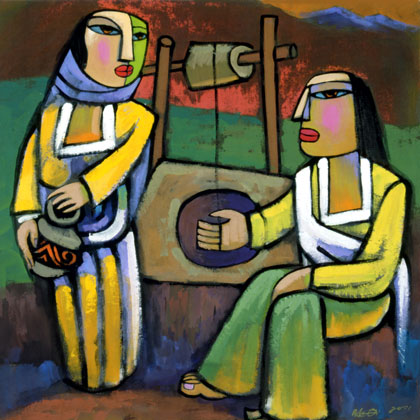
This is the verse that ends the well-known story of the woman at the well in the fourth chapter of John's gospel. The Samaritan woman who encounters Jesus there goes back to her village to tell them about him (in something of a hurry apparently; she left her water jar at the well). It's interesting to me that we typically make this story about what happened to her, while the passage actually goes on to tell a story about the rest of her village. We actually don't know what happened with her, though we do know what happened with her village. The others in her village actually respond to her report. They have a process of investigation - we see it in verses 39-41 - they didn't just fall prostrate at the feet of Jesus without further ado. They want to see who this Jesus character is for themselves. The word of one of their own got them that far, but more was required. They needed to experience Jesus, not just believe someone else's story about him. They wanted to have their own stories. They didn't want to live vicariously.

At the end of verse 42 the Samaritans respond, "...we know that this is truly the Savior of the world." John is choosing his words carefully. There are several words that can mean "to know" in Greek, and they're all nuanced differently. The word used in this passage is oidamen, which is the first person plural of the verb eidon, which has to do with knowledge gained by personal perception. You're not relying on someone else's testimony, though that might be the impetus for your investigation; you've seen it with your own eyes, you've verified it, and now you know something. You own it.

The Samaritans understood something that we forget: we can't live someone else's relationship with the Lord. We have to build our own, one brick at a time. We have to investigate it and critique it. We have to confront the things we think we know, find out that they were borrowed from someone else, then give them back and start over. The word of someone we trust might be important; maybe very important, but sooner or later we have to form our own, unique connection with our Savior.

When faith is acquired by way of our own experiences, it takes the shape of our souls; it becomes who we are and not just what we believe. You can't broker belief that someone else bought; you have to pay for your own.

Monday, January 24, 2011

The Wedding and the Wine

It's funny what happens when you come back to a story that you haven't read in a while. This morning I read the story of the wedding at Cana, the site of Jesus' first act of power, in John 2. I have a very different viewpoint on this story, and the bible in general, than I had years ago.

A brief synopsis: Jesus and his disciples are at a wedding feast in Cana of Galilee. When the wine runs out, Jesus' mother brings the issue to his attention, drawing what seems to be an irritated response from Jesus. In an interesting little exchange, Jesus' mother, ignoring his vexation, turns to the servants and instructs them to do whatever Jesus tells them to do. Doesn't that sound like something a mother would do? He has the servants fill six stone jugs, which were intended to be used for the Jewish purification rites, with water. Jesus then has the Chief Steward, the person in charge of making this wedding go off properly (kind of a 1st century wedding planner), sample the wine. The Chief Steward, unaware of the source of the wine, remarks to the bridegroom (whose honor was on the line if the wedding feast didn't meet expectations) that the best wine had been saved till last.

What's fascinating to me is the way Jesus re-purposes vessels intended for use in the Jewish purification rituals, filling them up with new wine that was better than the guests had received until that point. Even the bit about the way the inferior wine was usually served last adds to the meaning. The implication is that the Chief Steward *had* been serving the best that was available; what Jesus created was even better than that. Judaism was the best that was available until Jesus came; he created new wine, a new opportunity, something better and more like what God had intended since Abraham. There would be no use for purification rituals; Jesus would be, himself, the purifying act, who would fill empty stone vessels. One could even connect this image to Ezekiel 36, in which God promises to remove from us our hearts of stone and replace them with hearts of flesh.

The wedding feast was in danger of failing, of not being what it was supposed to be. Jesus rescues it with an act of creative power. Wedding imagery is a crucial lens through which the bible views our relationship with God, for bad (e.g., the wife of Hosea in the book that bears his name) or for good (e.g., Isaiah 62 or Matthew 22.1-14). It's so very appropriate that Jesus performs this miracle at this time in this place. The wedding God has always planned, where he would take us to be his bride forever, was on the brink of failure. Things were not as God had intended them, but Jesus changed everything with one act of creative power. What we have now is better than the best that was available then.

Of course, this all may be the merest coincidence. John may not have meant to convey all of the things I'm writing about. There's really no solid evidence that he did. I might be making all of this up, casting back into the story the things I believe to be true in retrospect. Maybe God does mean for us to know all of these things though, and it may be that he doesn't much care where they come from so long as they come.

It may just be me though. I'm prone to these kind of thoughts, here in this dark room early in the morning.

Wednesday, January 19, 2011

The Great Exchange...

I had a "eureka" moment this morning while reading Luke 23. Typical of "eureka" moments, I wonder now how I could have read this passage hundreds of times and missed this. It's that obvious.

The story goes that Jesus is brought before Pilate under charges of leading the Jewish people astray and (basically) fomenting rebellion against the empire. As Pilate examines Jesus, he quickly comes to the conclusion that he won't be able to make any of the charges stick under Roman law, and offers to release Jesus three times (compare to Peter's thrice denial of Jesus). Enter to laos, the "nameless mob" (see Joel Green's commentary on Luke), who up to this point have been Jesus' ardent supporters, but now show a nasty, fickle side: they turn against Jesus now, demanding the sentence of death for Jesus and the release of a notorious rebel and murderer, Barabbas. Pilate, in a show of weakness that typified his reign as governor, relents and does as they ask.

Aside from the rather obvious literary irony, I think Christianity has often made this passage about the injustice of the trade; the innocent dies and the guilty goes free. We've read the passage as a mere reinforcement of the fact that Jesus' death was unjust and undeserved. Yes, that's true. Here's the obvious thing though, the thing that made me laugh out loud at 6:15am:

We are all Barabbas.

We are all guilty, released in trade for the death of the Messiah.

We are all Barabbas.

We are not just people guilty of bad behavior; we are lestai, rebels and brigands just like Barabbas, convicted of insurrection against our just and rightful Lord, for which only one penalty has ever been appropriate.

We are all Barabbas.

We are the beneficiaries of our Lord's unfair, irrational love, of a verdict that seems unjust: "You are guilty; you may go." Because Jesus walked the road to Golgotha, we walk the road home.

This is the blessed exchange, wherein Jesus received the sentence we deserved and we received the sentence he deserved. It is the fulfillment of Isaiah 53.5:

"But he was wounded for our transgressions,
crushed for our iniquities;
upon him was the punishment that made us whole,
and by his bruises we are healed."

Monday, January 10, 2011

The Mercy of The Judge...

I heard a sermon a few days ago from a well-known pastor at a big conference. The gist of it was the question of who is at the bottom of your faith, you or God? Do we live to glorify God or do we love him because he loves us so much? Those are good questions...certainly worth thinking about. However, then he trotted out Matthew 25 - the Sheep and the Goats - making the age-old claim that some (presumably those who love God because he loves them so much) would not inherit the Kingdom of God even though they themselves were sure that they would. I'm not saying that this won't be a reality; it will. I hate it, but it will.

Here's the thing: I found myself, over the next day or so, pondering my behavior as a Christian. My anxiety rose as a tried to determine whether I was in category one or category two. Was my response to God correct? Was it adequate? Was it the specific response that he was looking for or would I find myself standing before Jesus on Judgement Day condemned, realizing that I'd been utterly deluded the whole time, that I'd walked through the green door when true justification was actually behind the blue door?

This morning I read Luke 18.9-14...the parable of the Pharisee and the Tax Collector. As the story goes, the Pharisee is absolutely sure that he's "in". He holds all the right values, does all the right things and has the identity badge of Torah - his get-out-of-jail-free card - to rely on. His prayer reveals as much. After all, who else would God be glorified through other than his covenant people? On the other hand you have the Tax Collector, hated by his people and excluded from the promises of God by his betrayal of the deepest Jewish values. He knows his condition and throws himself on the mercy of God. That is his only hope. Jesus points out that he goes home justified while the Pharisee does not.

The bottom line is this: after responding to the saving work of Christ in repentance and faith comes only one thing: continued response in repentance and faith. Loving God is about total reliance on what he's accomplished, not about searching for the "correct" or "adequate" behavior, the activity that makes me feel the most justified. In the end we will all throw ourselves on the mercy of the perfectly just judge, who will know perfectly that he himself has done everything necessary to secure our salvation not because we loved him but because he loved us (John 4.9-10).

In this and this alone is God glorified: our total reliance on the fact that he has done what only he could do. Lord, make me like this Tax Collector...